Monday, August 29, 1994

Which Beach is It?

We were constantly wondering where Dad actually landed as we were walking Omaha beach. There were multiple reasons for this given the general lack of available information at the time. First, the 467th AAA was deployed up and down the beach for general protection and assistance of the landing forces. Second, due to beach congestion issues, smoke, confusion many of the LCTs came ashore in unintended locations west and east of the St. Laurent location.

After our trip, in the last few months of 2011 actually, I was lucky to find records of the actual LCTs that carried the 467th AAA units and was able to piece together some of the puzzle. Also Hyman Haas’ biography helped tremendously since he was in the same Platoon of Battery A and in the same LCT that morning.

dday_omaha-1994-08-29-14-00-1994-08-29-14-00-1994-08-29-10-00.jpg

Dad landed as part of Unit 4, 1st Platoon of the 467th AAA Battery A which was the first 467th AAA Battery to land. The 467th AAA AW Battalion was attached to many different landing groups through the D-Day landings and often due to reduced air threats ended up applying their weapon carriages to the defenses in the hills.

As some 467th AAA Battery level organization background, there are 2 tracks to a unit an M15 and M16 and there are 16 tracks in all for a total of 8 units/16 halftracks in the Battery A commanded by Captain Napier at the time of the landing. There is a command unit.

From one record here was the plan:

6 June 1944 - Entire Battalion (less residue) landed on Beach 46, near St Laurent-sur-Mer, France as follows: Battery "A" 0830 or around H+120.

From my Dad’s oral record he says he was in around 0840-0900 (Hyman Haas predicts earlier 0800-0830 but there is likely a little slop here in the recollections). But its almost certain he wasn’t in one of the pushed back LCTs due to beach congestion or damage and he remembered going in with Captain Napier so this eliminates quite a few other LCTs. My Dad’s Sergeant was Robert Stratman and in an email from Hyman Haas he indicated that the unit was right behind them on the same LCT. Being in the same Platoon this likely makes sense and probable. From Hyman Haas’s account it sounds like the first platoon also moved to the right upon landing and was located near the middle-west edge of Easy Red.

From Hyman Hass’ Bio

“We left Portland harbor at about 8PM amidst much whistle blowing, it seemed as if every ship was blowing its fog horn. There were ships and boats of every description everywhere. I couldn't help reflecting that we had, since leaving Exmouth seen and were part of one of the greatest spectacular events ever. At this time during our departure from the port of Portland the scene of all those ships were overwhelming. Fast Cutters pulled up nearby and men with megaphones were shouting "GOOD LUCK" at us. They were cheering at us and we were cheering back. We took our place in a long line of LCTs and made our way into the English Channel. By the time it got dark I decided that I had better get some sleep. Up to this point I had given little thought of what the landings might entail. The thought that I might be killed or wounded never entered my mind. The spectacle was too overwhelming and besides I had so many details to see to that I had no other thought than to digest and memorize all the information that was given to me. I fell asleep immediately. Sometime later I was shaken awake by our Corporal; "Get Up, Getup, We're turning back, the invasions been called off." After I fully woke I went to our 1st Sergeant who told me the operation was probably postponed because of the weather. The weather looked good to me. I could feel no rain, spray yes. As there was nothing I could do about it I went back to sleep and when I awoke we were back in the same spot we were in before we left. I didn't know whether to be disappointed, or not.

     I can't recall the hour when we were told that the invasion was on again. That evening we repeated the departure scene over again. The same activities and spectacle. This time I didn't go to sleep. Again I couldn't tell the time when we heard the motors of hundreds of Planes. We couldn't see then as it was pitch black, we couldn't see our hand in front of our eyes. We kept on sailing our excitement rising. Whatever spectacle we had witnessed before would soon be replaced with another kind. In those latitudes there was only about 4 hours of dark at night. We first saw the first glimmers of light very early that morning and as it got lighter ships of all kinds became visible. Destroyers, Cruisers and Big Battleships. There were Ocean liners and men were climbing over the sides on nets and into small Higgins boats and then they started circling. We had stopped near a big Battle ship. At about 05:30, or so I think, it could have been earlier. The Battle Ship let go a salvo with all its big 15 inch guns. I had always wanted to hear what one of those salvos sounded like. The sound wasn't like the distant thunder I had imagined. It was like a very loud rifle shot with plenty of concussion. A sharp crack. Then the shell could be seen as all the shots were tracer. We then heard the Bombers overhead. They were to bomb the beaches. There seemed to be no end to them and all the cannonading from all the naval vessels acting as field artillery. To our right about a half mile away a LCT with rockets let go with all they had. Between the Battleship and the Rocket LCT we were witness to some terrific Bombardment. We were told that the battleship was actually firing in support of the Utah Beach landings. We never found out the name of the battle ship, perhaps she was the Texas.

     06:30 the bombardment stopped, with the Airforce and the off shore bombardment so terrific we couldn't see how anything could be left alive on the beach. We also knew the engineers had landed so they could blow up any beach obstacles. The morning though overcast was showing lots of light, we couldn't see the shore as there was much fog and smoke. All we knew was the first men were ashore. We couldn't estimate how far from shore we were, but at 07:00 AM a boat pulled near and again a man with a megaphone yelled at us;"Go On In, GOOD LUCK. Well that started us off. We began our run onto Omaha Beach.

     The run in took at least a half hour and probably more. We had no idea of what was happening on the beach, except as I looked over the side I saw the body of a GI floating by. A short while later a shell exploded about 20 feet away on my side. Somebody had targeted us. There were one or two more shots and Captain Napier yelled that everyone should keep our heads down during the run. We were near the beach I still couldn't see what was ahead, except that the smell of smoke was heavy. We could clearly hear the distinctive sound of German Machine guns. They had such a high rate of fire they sounded like a burp and that's how they got the name burp guns. We had long ago been told that and now we were hearing the sound again. We had found a clear spot through the obstacles and made for shore and soon the ramp was down and we started our motors. Every motor started and soon we were ready to land. Someone gave out with a Rebel Yell and our 1st Sergeant who had been looking out in the front of the LCT shouted back; "Shut up you shmuck! In a minute you may be dead!" The Captain's command Halftrack was off first and as he got on to the beach he turned right (West). We all followed suit. I found we weren't exactly on shore as when we went in I was sitting in the cab of the Half track with the driver and the water went up to my chin, I grabbed my rifle and the driver's Thompson machine gun and held them over my head. I thought the driver would be completely under water. But he wasn't and we were soon ashore and we turned right and made for our place 30 feet from the vehicle ahead of me. My M16 was soon 30 feet behind me. In minutes the entire platoon was ashore. The noises of mortars and German Machine guns were louder and as I looked ahead the shore was littered with landing ships and craft. All aflame. I didn't know where to look first when I looked up on the Bluffs ahead and spotted a bunker that looked to me to be built into the hills. At the same time I also spotted an American officer with a full handle bar mustache and wearing shiny cavalry boots running towards me pointing at that German Bunker. Captain Napier was standing near me and he said "Go Get it.. I immediately saw we couldn't fire ahead because of our barracks bags being piled up in front so I ran into the surf and signaled my two Half tracks to follow me into the surf. They caught on immediately and turned right and drove into the surf deep enough to cover our tracks and wheels. I took up a position behind the rangefinder and in an instant we opened fire. We missed our first three shots as a shell went past us. I made an adjustment on the rangefinder and the next 15 shots went right into the gun port of the bunker. All the time my M16 were firing their 4 50 caliber machine guns at the bunker. No doubt the Bunker was dead.

     Breathing heavily with excitement I recalled the Halftracks out of the surf and now we were standing by and we could see the results of the German machine gun, mortar and artillery fire. There was complete Chaos on the beach in front of us. On our right all Giant LSTs, LCTs, LCIs were afire and exploding ammunition. It was difficult to see if any one was alive in, or on the ships and craft. To our left on the shore were tremendous amount of dead and wounded soldiers lying about in all positions, as we looked further we could see parts of bodies, arms legs, heads. We made our way through this Valley of death taking machine gun and mortar hits and adding to the casualties. We went through a blown hole in a wall, many of our GIs had taken cover by this wall and they died in groups or just been blown apart. We made our way through the opening of the wall and found ourselves on soft beach sand. and then the mortaring began . The sound of their coming sounding like the fluttering of a small birds wings I noticed an infantryman jump into a fox hole and a mortar shell went in with him.We were out of our Halftracks and under them for cover, some of the mortars flew right into three of our tracks. Suddenly the mortaring stopped and then A large LST blew up and sent a large amount of burning oil over our heads putting the bluffs ahead of us on fire. It seemed to me that every thing was on fire and that it wouldn't be long before we would all be dead. Panic wasn't far away. Somehow we kept together and soon we got the order to proceed ahead to the Beach exit and ride to the top of the bluffs. The Beach exit was called Exit E 1 and it led to the town of St. Laurent. On the way up the road we paused in front of the bunker we had knocked out and there were two wounded German soldiers lying on the parapet of the bunker: one of them was vomiting blood. As we waited to go on Macneil the Chief of section 2 ran over to me and shouted "Hey that's your bunker." For a while I thought he was accusing me of killing the Germans. Of Course he wasn't. Everyone was in a keen sense of excitement. We all were gasping for breath even though we weren't moving. We moved on away from the unsettling scene of the dying German soldiers. We Made our way to the top of the bluffs and soon the sounds of battle began to recede from our area and we began to breath a little freer. But not for long. We had dug foxholes and, from force of habit in training, a latrine. It was that latrine that a sniper took aim at. He wasn't a good shot as he missed whomever he aimed at, but whoever used that latrine had a shot aimed at him. We knew about the sniper and we couldn't locate him. Still whoever came to us and asked where our latrine was we pointed at it and sent the guy to it. A shot was followed by near hysterical laughter as the latrine user began to scatter away. None of us could explain why it was that we never warned any one away. We actually were looking for the sniper to show himself and he did to one of our men in another section who aimed his 4 50 caliber machine guns at him and stopped the comedy. We were off the beach and the sun came out and warmed us. We were soaking wet most of the day and now we began to dry. The most depressing thought we had was that what we had endured even though it seemed we had won a toehold on the beach was this day was only the beginning. We had no sense of victory, only dread. We had seen war up front there was nothing ahead but more of the same.. We weren't wrong.

     We stayed on the top of the bluff, a sort of plateau where eventually an airfield was built, three, or four days without any incident aside from the spectacular displays of AA fire coming from the ships anchored off the beach. Some, not many, German bombers came in after dark and dropped bombs, or tried to bomb the ships. I watched the display as we were told not to fire at night from our position. I recall the one time a lone german plane scored a hit. The ship blew up with a terrific explosion that turned the area blood red. The strange thing was that all the ships were firing and did so every time a german plane come buzzing over the ships. The sky was literally filled with tracers and explosions and not once did they bring a german plane down. At that position we sort of recouperated from the trauma of the landings. I recall the first food we ate was over 36 hours since our last meal. As armored and mobile troops we carried plenty of food and the utensils to cook though at that time we had the 10 and 1 rations which weren't bad. In addition we were issued, before we left the marshalling area, some sort of concentrated Chicken Soup which came in a self heating container. To heat the soup we pulled a string, or something and the soup heated. We each were issued 4 cans. and that was the first food we ate when we finally simmered down. The soup was delicious and we wolfed down three each before we decided to stop. After that we sort of normalized we took the waterproofing off our Half Tracks and made coffee. We had lots of ground coffee and we kept a pot on our stove. We also were issued a small two burner gasoline stove that you had to pump up before you lit it. We even gave passing Generals coffee.

       We would have been satisfied to stay in that spot for the duration but we got our march order after three, or four days. Our position atop the bluff felt like home, we never went far from it, not even to go back and look the landing beaches over. We'd seen enough of the landing Beach.”

The following map is an overlay map I made of what i could gather of landings from LCT after actions and verbal histories from 467th members.

Red is likely the rough area for the 2nd Platoon which landed slightly later on the famed LCT-30 and met with significant resistance. Blue is my best estate of the 1st Platoon area (Capt Napier had all halftracks go right (west after landing)) and this could have kept them out of some harm. To shoot at WN65 means likely Sgt Haas would have to have moved slightly east into position in the surfline after being told to go after it in order to get a clear shot at the gun. The LCT for platoon 1 was bound for Easy Green but could have easily drifted East into Easy Red territory as many LCTs in this area drifted Eastward that day.


likelylandings-1994-08-29-14-00-1994-08-29-10-00.png

HEADQUARTERS

FIRST UNITED STATES ARMY

APO 230

GENERAL ORDERS NO. 58

15 September 1944

Technician Fifth Grade Prue M. Collier, Medical Detachment, 467th AAA Battalion (SP), United States Army, for gallantry in action on 6 June 1944, in France. Early on D-Day, Technician Fifth Grade Collier, landing with his platoon on Omaha Beach under devastating enemy artillery, mortar, machine gun and rifle fire, completely disregarded his own safety to render aid to the wounded. He continually exposed himself to the incessant enemy fire for a period of 5 hours despite the pain from serious leg wounds and it was not until additional aid men had arrived that he agreed to be evacuated. The spirit of self-sacrifice of Technician Fifth Grade Collier in disregarding his own safety and injuries in order to help his comrades saved many lives and was an outstanding factor in maintaining the morale of the men on his beach.

By command of Lieutenant General HODGES:

HEADQUARTERS

FIRST UNITED STATES ARMY

APO 230

GENERAL ORDERS NO. 64

28 September 1944

Sergeant David M. Feit,Corporal Charles B. Patton,Private Glenn D. Bussard,Private Ben G. Clay,

467th Antiaircraft Artillery Automatic Weapons Battalion (SP), United States Army, for gallantry in action against the enemy on 6 June 1944, in France. Their platoon was pinned down on the beach on D-Day by very heavy machine gun fire, when a landing craft loaded with infantrymen struck an underwater obstacle nearby and overturned, throwing all the men in to the deep sea. The enemy immediately directed machine gun fire on the men struggling in the water, but these men voluntarily and courageously left their relatively safe place on the beach and swam out through the heavy fire to aid the wounded and drowning men. They assisted in rescuing some 15 infantrymen and by their heroism set an inspiring example to the men of their unit.

By command of Lieutenant General HODGES:

HEADQUARTERS

XIX CORPS

APO 270

GENERAL ORDERS NO. 43

11 October 1944

Captain Raymond T. Napier, Coast Artillery Corps, 467th Antiaircraft Artillery Automatic Weapons Battalion (SP), United States Army, for gallantry in action against the enemy in Normandy, France. On 6 June 1944, Captain Napier, landing on the beach at 0840 hours, despite numerous beach obstacles and intense machine gun fire, immediately set out to locate a well protected position for those of his vehicles which had cleared the landing craft. Moving steadily inland under intense enemy fire, Captain Napier, making quick decisions based on his reconnaissance, was able to move his vehicles so that they were never hit by enemy artillery fire. Captain Napier's leadership and disregard for his own safety contributed immeasurably to the establishment of the beachhead and reflect great credit upon himself and the military service. (Award made posthumously.)

By command of Major General CORLETT:

HEADQUARTERS

FIRST UNITED STATES ARMY

APO 230

GENERAL ORDERS NO. 10

17 January 1945

Captain Paul N. McCarthy, 467th Antiaircraft Artillery Automatic Weapons Battalion (SP), United States Army, for gallantry in action against the enemy on 6 June 1944, in France. On D-Day, Captain McCarthy's battery was subjected to concentrated 88mm and mortar fire. Many vehicles carrying vital supplies of ammunition received direct hits. The resulting fires and explosions threatened the lives of his men and necessitated the constant shifting of the vehicles. At great personal risk, Captain McCarthy, braving the enemy fire, personally directed the unloading of ammunition and evacuation of the vehicles. By his heroic actions and courageous leadership, Captain McCarthy reflected great credit on himself and the military service.

By command of Lieutenant General HODGES

Next: Snails on the Hills

First Look at Normandy Beaches

Our first view of the Omaha Beach area was beautiful and we stopped by directly on the way from Cherbourg in our rental car. There was a beautiful set of memorials to many of the Allied units and participants that had landed at the Vierville draw entrance and we walked through and read many of these monuments. Then we walked down the beach for quite awhile.

1994trip_normandy8-1994-08-29-13-44-1994-08-29-09-44.jpeg

John and I felt we needed to give Dad some time alone to walk and reflect so we gave him some private space as he began walking down the beach and looking around. You could tell he was in deep reflection. After awhile he called us over so we rejoined him.

1994trip_normandy10-1994-08-29-13-44-1994-08-29-09-44.jpeg

Dad wanted to take some of the sand back home with him so we had several film canisters with us that he began loading up with sand form Omaha. John and I also each filled up some canisters to bring home.

gettingsand-1994-08-29-13-44-1994-08-29-09-44.jpg

We walked up and down the beach for awhile exploring each draw and open space. In this Western section there were sidewalks and homes above parts of the beach since 1944 but it was still a fairly quite and serene beach and we were instantly impressed that things had not been overdeveloped over the 50 years since the landings.

1994trip_normandy15-1994-08-29-13-44-1994-08-29-09-44.jpeg1994trip_normandy19-1994-08-29-13-44-1994-08-29-09-44.jpeg

The hills are still filled with bunkers, interlaced underground passages, and interesting artifacts. Its hard to erase the huge engineering efforts that went into setting up such an extensive German defense system and the scars that were also left from the liberating forces fighting their way off the beaches.


Next: Which Beach is It?

Port en Bessin: Our Normandy Home Base

Port-en-Bessin

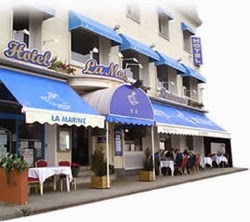
A port village nestled between the American and British Landings became our “home base” of operations for the several days we explored the surrounding area. Hotel de la Marine was comfortable and we enjoyed the food, the town, and the general peacefulness of the town was relaxing and a perfect match for our moods.

A canal system comes from the ocean port into the center of town since the tides shift so dramatically this canal is required to keep the docked boats afloat at low tide. Here is Dad and I looking back into town and part of the Hotel de la Marine is on the right of us.

1994trip_normandy2-1994-08-29-11-18-1994-08-29-07-18.jpegfacade_marine_perspective-1994-08-29-11-18-1994-08-29-07-18.jpg

This was hotel were years ago Jean and Clara had driven Sandra and I from Angers for an overnight trip. Great food and a nice typical Normandy sea town. I absolutely love this place. They had done renovations which made it even nicer.

The town has a number of nice local shops for pastries and places for galettes (see later story). The Hotel de la Marine served a nice dinner back then and we splurged which was perhaps the best meal of the trip.

Here were are out on the pier jutting into the Ocean to the left are the cliffs above which we saw all the snails climbing through the grass in the morning that is discussed in another article.

1994trip_normandy-1994-08-29-11-18-1994-08-29-07-18.jpeg

I noticed that this plaque has been erected on the town pier for the 60th Anniversary commemorated the fact that the town was a major fuel supply area important to supporting fuel importing for the later inland campaigns.

800px-Port-en-Bessin-Huppain252C_Calvados252C_Tablet_of_the_D-day.JPG-1994-08-29-11-18-1994-08-29-07-18.jpg


Next: First Look at Normandy Beaches

Sainte-Mere-Eglise

On the way from Cherbourg was Sainte-Mere-Eglise and we stopped there for awhile to look at the town. The 467th AAA had moved to protect this area and other surrounding towns, Carentan and Isgny, in the weeks directly following the D-Day landings.

Some of the earliest landings by paratroopers at 0130 on June 6, 1944 occurred here and the buildings in town were on fire that night, likely from pre-raid bombings, making easy targets of the descending paratroopers. Many landed in the fires or were caught hanging from trees and poles and shot before they could cut loose. The German were also alerted in this area that something was up.

Paratrooper, John Steele, got caught on the spire of the town church, and could only observe the fighting going on below. He hung there for two hours, pretending to be dead, before the Germans took him prisoner. Steele later escaped from the Germans and rejoined his division when US troops of the 3rd Battalion, 505 Parachute Infantry Regiment and attacked the village with great success.

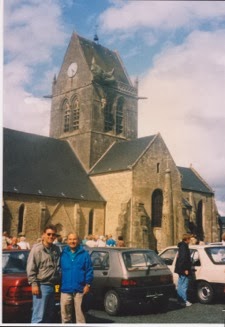
Who can forget the parachutist representing John Steele’s situation hanging from the Church steeple played by Red Buttons in the “The Longest Day”. The locals have immortalized the scene by keeping a replica hanging from the church to this day. Its right behind us in the below picture if you look closely.

1994trip_normandy1-1994-08-29-10-05-1994-08-29-10-05.jpeg

Next: Port en Bessin: Our Normandy Home Base

The Ferry to Cherbourg

The next step in our journey to partially trace Dad’s pathway through Europe was to cross the English Channel.

We took a morning ferry from Portsmouth to Cherbourg, France and arrived in the afternoon. We reach Normandy soil via the sea just as Dad had done but as Dad said on the ferry trip over “Its alot nicer this time!”

We see the famous HMS Victory (we actually toured the previous day) and HMS Warrior on the docks.

1994trip_england52-1994-08-29-08-00-1994-08-29-08-00.jpeg1994trip_england53-1994-08-29-08-00-1994-08-29-08-00.jpeg

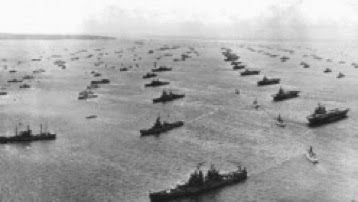
We walk the decks and enjoy the fresh air and there is a a feeling of silent anticipation as we approach the Normandy Coast. As we look around, John and I try to imagine the sight of seeing ships “as far as the eye can see” crossing the Channel.

armada-1994-08-29-08-00-1994-08-29-08-00-1994-08-29-08-00.jpg


Next: Sainte-Mere-Eglise

Saturday, August 27, 1994

Portland Bill

Heading off to Portland Bill from the Tank Museum to see where Dad debarked in their assigned LCT on the eve of D-Day. Well the 467th AAA Battery A was actually stationed here for several days before and left and sailed for the D-Day landings on the eve of June 5th a day before and had to do it all over again when it was called off.

Again we have rough clues of where are going and exactly what we are looking for but this part of England is really beautiful and we enjoy the drive to Portland Bill which juts out from the South English coastline like a teardrop of land. Its a wonderful piece of land and is fairly rugged so we can’t see very far once we get into town making old-fashioned pre-GPS navigating difficult. Dad only partially remembered the location since so many things changed in 50 years. We first head towards the front of the Bill towards the lighthouse and get out of the car and begin walking down the slopes. Lots of sandy, grassy slope leading to pristine beaches where families are picnicking and vacationing. Beautiful but we are after the traces of another history and trying to find some evidence of debarkation and this side of the landmass isn’t it. Our difficulty in finding the location sounds ridiculous in the post 2000 era of instant information and geopositioning but this was 1994 and paper maps with scant information where still king so we are hunting around using our eyes and ears and talking with a few locals.

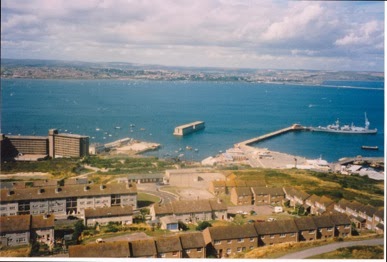
We drive down many streets and as I mentioned the hilliness makes navigating difficult once on the island even though its small. Again we stumble upon a street winding down the back side of the Bill and this leads down to the docks and port areas that are still in use today. We get lucky again in our searching as Dad begins to recognize the surroundings and we will also spy several partially sunken remnants of Mulberry harbors and we see a Landing Craft Tank (LCT) perhaps put there for the 50th anniversary a month earlier. We aren’t sure about why its there. Mulberry harbors are large cement rectangular shaped artificial harbor pieces that can float and were towed to France during the invasion to establish an artificial supply harbor which aided in quickly unloaded troops and supplies once the beach areas were secured to support the push inland. The initial landing is challenging but the sustainment of a large invasion force requires equipment and supplies and this was critical to later successes in sustaining the liberation forces. So we were initially surprised to see direct evidence of D-Day equipment and massive construction efforts 50 years later.

portlandfromhill-1994-08-27-13-00-1994-08-27-13-00.jpg

Dad is feeling positive that these are the dock areas they assembled and left from and the historical documentation backs it up. He is happy we have gotten this far and found another step along his path from 50 years earlier.

While we are in the dock area he recalls a story regarding their assembly for debarkation. He remembers that they were all lined up in rows and columns extending from the waterfront and it was announced that “those closest to the water will be landing first”. He looks down and the waterline is right in front of his unit.

halftrackinLCT-1994-08-27-13-00-1994-08-27-13-00-1994-08-27-13-00.jpg

That evening I get a chill when thinking about what waiting for the word to go must of been like for so many young men. When we ask Dad what it felt like he offered some words of reflection. “It wasn’t so bad for me because I didn’t know what I was getting into just out of high school, through training, and suddenly in Europe. It was probably much worse for the older veterans who had an idea of what was ahead”.

Transcript of Ike’s Message to Troops:

Soldiers, Sailors and Airmen of the Allied Expeditionary Force! You are about to embark upon a great crusade, toward which we have striven these many months. The eyes of the world are upon you. The hopes and prayers of liberty loving people everywhere march with you. In company with our brave Allies and brothers in arms on other fronts, you will bring about the destruction of the German war machine, the elimination of Nazi tyranny over the oppressed peoples of Europe, and security for ourselves in a free world.

Your task will not be an easy one. Your enemy is well trained, well equipped and battle hardened, he will fight savagely.

But this is the year 1944! Much has happened since the Nazi triumphs of 1940-41. The United Nations have inflicted upon the Germans great defeats, in open battle, man to man. Our air offensive has seriously reduced their strength in the air and their capacity to wage war on the ground. Our home fronts have given us an overwhelming superiority in weapons and munitions of war, and placed at our disposal great reserves of trained fighting men. The tide has turned! The free men of the world are marching together to victory!

I have full confidence in your courage, devotion to duty and skill in battle. We will accept nothing less than full victory!

Good Luck! And let us all beseech the blessings of Almighty God upon this great and noble undertaking.

-- Gen. Dwight D. Eisenhower

British divers still explore to this day the leftover remnants and wrecks of LCTs and Mulberry harbors around Portland Bill.

See this website for more info.

http://www.britishdiver.co.uk/2012/01/d-day-landing-craft-and-bombardon-unit/


Next: The Ferry to Cherbourg

Tank Museum

Ok so if you haven’t read the introductory articles Dad was (TEC-5) in a halftrack in Battery A of the 467th AAA throughout his European campaigns. I have some earlier articles and referred google maps in this series about the specifics of the 467th AAAW campaigns and attachments throughout the war.

Dad’s unit #4 of Platoon A had two vehicles an M-15 and and M-16 halftrack.

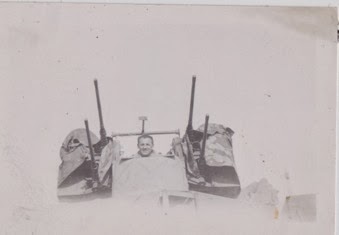
The M15 mounted one 37mm automatic cannon and two .50 cal machine guns with all three bores being parallel. Dad was in the M15 and the other track in their unit was the M16. The M16 used a quad-mount of four .50 cal machine guns. There was a place to sit in the back the gunner (sighter) would sit to control firing with two foot pedals left and right. Hand cranks were used to control horizontal and vertical rotations. We were discussing this during the trip and Dad told me as a gunner in the crew he had relatively short legs and the firing pedals were a little far away creating a problem! His buddies solved the problem by taping wood blocks to the pedals so he could reach to more easily fire. No problem, expensive equipment with limitations .. innovate in the field..

Here is a top view of the M15 with the firing foot pedals that follows (minus wood blocks).

M15top-1994-08-27-09-00-1994-08-27-09-00.jpgM15pedals-1994-08-27-09-00-1994-08-27-09-00.jpg

Below is a modern restoration demonstration of a quad .50 halftrack on youtube in case you want to see one on the move.

http://www.youtube.com/watch?v=Qig25332VOA

Back to our story, we are hoping to find a restored AAA halftrack during our trip and we were lucky enough to be near the world’s largest tank museum which is in Southern England.

http://www.tankmuseum.org/

Ok, remember these halftracks are extremely rare today there are perhaps a few around the world that have been restored and we are not sure they have one. We got up early and our plan was to hit the tank museum in the morning and then Portland Bill, Dorset in the afternoon then return to Portsmouth. We got in the rental car and drove to the tank museum, no problems. Parked and walked inside and the first impression was that it was huge. The first part of the museum was really nice:

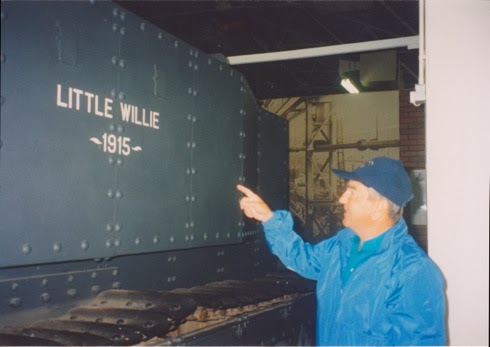
Old tanks from World War I: one called the “Little Willie”. Dad loved that since it was his nickname. Oops that was a secret! Really he’s a short basketball player and his name is William. We all had a good laugh.

1994trip_england21-1994-08-27-09-00-1994-08-27-09-00.jpeg

Also Tigers, Panzers, Shermans all in rows and rows that seemed to go on forever in several warehouse like buildings. But after 40 minutes or so a tank is a tank right? Its getting a little repetitive and still no AAA halftracks..we want halftracks! We are getting towards the back of the museum and starting to lose hope.

1994trip_england31-1994-08-27-09-00-1994-08-27-09-00.jpeg

Then a sign appears pointing to a non-inviting, semi-closed hangar area

“ EXPERIMENTAL VEHICLES -> THIS WAY”

The proprietor tells us its for strange vehicles and things that did not quite make it to deployment but as he recalled there just might be a halftrack back there you could look and see. What did he say he doesn’t really know whats back there but theres a chance? We proceed to check it out.

Weird stuff appears as we made our way through the cluttered hanger area. Its the Island of Misfit Toys.

(1) First thing I see is stand-up tank that fits one standing man like a small jiffy john with small set of motorized treads on the bottom and a little tiny gun hole to shoot out.

        - The sign should read “HUMAN DEATH TRAP!”

        - I see why that one didn’t make it.

(2) Passing other early robotic tanks and other weird collectables that could easily be from an H.G. Wells novel. Captain Nemo rejects!

Getting ready to give up on the AAA halftrack and leave but we look around one more corner. And there she is dressed up in her .50 caliber quad turret splendor. Its not the M15 configuration that Dad rode on but its one of the M16s used in their close-knit unit as the companion vehicle and its cleaned up, restored, and looking new. Truly unbelievable, because we never expected to really find one. We poke around it and take some pictures with Dad. He’s happy, we’re happy its a good day because we came a long, long way and we got dealt a fullhouse. Nice!

m16_2-1994-08-27-09-00-1994-08-27-09-00.jpg


Next: Portland Bill

Friday, August 26, 1994

Warwick Pub and Project Overlord Headquarters

Heading off from Portsmouth to Warwick village had Ales at the tavern where Eisenhower would drink with his staff.

1994trip_england2-1994-08-26-00-17-1994-08-26-00-17.jpeg

Enjoyed some nice talk a light pub lunch and a few Ales. I could tell Dad was beginning to relax and enjoy this.

Visited the Project Overlord exhibits at Southwick House.

attack_r-1994-08-26-00-17-1994-08-26-00-17-1994-08-26-00-17.jpg

This is the location where the Supreme Commander and staff basically planned the operation.

The giant map board used for planning the Normandy invasion is still there and set for H hour. Here is John and Dad in front of the big board and clocks that were used in planning the Operation Overlord.

1994trip_england7-1994-08-26-00-17-1994-08-26-00-17.jpeg

We hear about the stress and the significant issues Eisenhower was facing in making this tremendous decision with some many lives and issues at stake. The uncertainty of the weather was not helping and they needed to do this when the tides and the weather were right. The responsibility was extreme and it rested ultimately on one man’s shoulders to decide when to go.

..An excerpt about Eisenhower’s decision at Southwick house.

“Ike paced and paced in the now silent room.  Minutes passed that seemed like hours.  In addition to weather and logistic woes, he knew that holding the men a further two weeks carried the same risks then as now.  And by then German intelligence would have detected the build-up and the Normandy location.  Ike's invasion force compared  to secretly moving overnight across Lake Michigan the combined populations of Kenosha, Racine and Green Bay, Wisconsin - and with all their vehicles in a heaving storm.  The chain-smoking commander stopped, turned to his staff, and quietly but firmly said, "OK. let's go."

Within thirty seconds the room emptied, leaving only a drift of blue smoke over the table, a glowing fire reflected on the polished wood floor, and a brooding General Eisenhower sitting alone near the hands of a mantelpiece clock pointing to 945pm.  Only fifteen percent of Ike's invasion force knew combat.  Fearing the worst, Eisenhower later penciled a note for the press: “Our landings have failed and I have withdrawn our troops…if any blame or fault attaches to the attempt it is mine alone.”  Across the roiling English Channel, an obscure Normandy beach code-named Omaha impended in the murk.  General Irwin Rommel's seasoned army outnumbered the Allies ten to one.  The invasion of Europe was underway, and even Ike couldn't stop it.”

See this great article to learn more:

http://www.historyarticles.com/southwick.html


Next: Tank Museum Visit

Portsmouth

August 26, 1994: Friday

Headed to Portsmouth to stay at a hotel for a few nights as our main base of operations, I believe it was the Queens Hotel in Southsea.

We had a real Hotel debacle at the Queens Hotel as we had made reservations via fax and phonecalls (early 90s technology) but they had no record of our reservation for the first night and no rooms. After some arguing and even after I produced a printed copy of the reservation info they said there wasn’t anything they could do until the next day and they gave some info on other close locations that might help. We found a nice B&B nearby and we got settled into this nice comfortable house and right away asked the owner if we could stay here the rest of our trip. Yes was the answer, no problems. Way better than the hotel we thought. Good beds, nice bathroom, and great breakfast (awesome bangers) and I do remember also getting a great night sleep.

The next morning we hit the D-Day Museum across the promenade and open grassy areas so we easily walked there. Nice embroidery of D-Day events at the museum, I thought that was unusual but interesting. An old tradition I guess dating back to the Middle Ages, the Bayeux Tapestry for example. The rest of the museum was pretty nice and good start to our trip. The British love and maintain museums of all sorts! Good for us because we took advantage on this trip over and over again. This was a good start to our trip and made a nice base to explore parts of the Southern English Coast. Here is a tapestry representing Omaha Beach.

1994trip_england15-1994-08-26-10-00-1994-08-26-10-00.jpeg

Great museum with great links to other information http://www.ddaymuseum.co.uk/d-day/d-day-links

Cool timeline from the D-Day museum in Portsmouth

D-Day hour by hour: OMAHA Beach on D-Day

First Allied troops to land: 16th Regimental Combat Team (US 1st Division) and 116th Regimental Combat Team (29th Division), 2nd and 5th Ranger Battalions.

The beach had strong German defences. The German troops stationed there were in greater numbers, and of higher quality, than the Allies had believed.

Objective: The only breaks in the 100-foot high cliffs running between UTAH and GOLD Beaches were at OMAHA Beach. The landings at OMAHA were therefore vital to connect the US troops at UTAH Beach with the British and Canadian beaches to the east.

Landing craft are loaded 11 miles from beach, leading to problems with rough seas. Ten landing craft sink.

05.35 – 27 DD (swimming) tanks sink on launching in rough seas.

05.55 – The Allied naval barrage and bombing raids on the German defences are ineffective.

06.35 – The first units try to land, but are cut down in the surf by defenders' fire. There is terrible carnage.

07.00 – Chaotic situation on the beach, as troops are pinned down and take cover behind mined beach defences. Engineers are unable to clear obstacles.

07.08 – 2nd Ranger Battalion Lands and assaults Pointe du Hoc, the site of a battery of German long-range guns (to the west of the main landings on Omaha Beach).

07.30 – The second wave of troops adds to the confusion and over-crowding on Omaha Beach.

07.40 – 5th Ranger Battalion lands on beach.08.00 – The attack up the cliffs begins, assisted by tanks and destroyers firing from close inshore.

08.30 – Rangers and 116th Infantry reach top of the cliffs at Les Moulins.09.15 – After scaling 80-100 foot cliffs at Pointe du Hoc, the US Rangers find the battery empty, but discover the guns further inland and destroy them.

10.00 - 11.00 – The advance on Vierville and St Laurent gradually begins. The beach is very congested.

11.00 – Vierville is captured.

12.00 – German defences are penetrated in four places. US troops begin to move inland, although the beach is still under heavy fire.

14.00 – The first beach exit is cleared.

16.00 – Tanks and vehicles begin to move off the beach.

20.00 – St Laurent and Coleville are captured.

24.00 – A tiny, precarious beachhead has been established. There are pockets of US forces over an area approximately five miles wide by 1.5 miles deep.OMAHA Beach was the worst of all the Allied beaches on D-Day. By midnight, 34,250 troops had been landed, with around 2,000 casualties. Three men won the Congressional Medal of Honor.

Next day we plan to visit Eisenhower Allied Command post from where Operation Overlord, the Normandy Invasion, was planned.

OUR BAGS ARE GONE!

Anyway we get back to our B&B and our bags are gone. Which is unusual because we had everything unpacked and put away for the next few days so it doesn’t seem like a robbery because they took everything toothpaste and all. It turns the hotelier came and just took our bags back to the hotel since they had open rooms the next day. He threw our stuff in our bags in a haphazard manner as well. We were not happy about not be consulted and getting our permission to just take our belongings. He attempted to talk us into an o.k. not great room at the hotel but we were having none of it and got back to the B&B where they were welcome to have us for a few more nights. I think we were just mainly pissed off that the reservations were messed up and that he had just grabbed our bags, repacked them and moved them. It was a good decision to stay at the B&B and their mistake worked in our favor.


Next: Warwick Pub and Project Overlord Headquarters

Thursday, August 25, 1994

Touring London

London was great but a short stay. Here is a brief overview of the day.

1994tripphotos1-1994-08-25-06-30-1994-08-25-06-30.jpeg

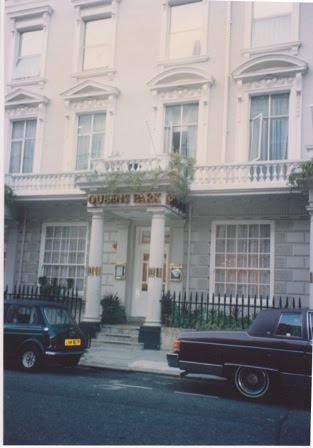
Left the Queens Park hotel heading across Kensington Gardens and Hyde Park on a beautiful day.

1994tripphotos17-1994-08-25-06-30-1994-08-25-06-30.jpeg

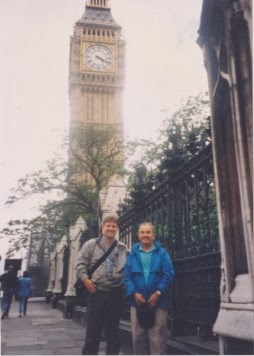
Passed by Buckingham Palace on our walk and then headed off by Parliament area and spent time at Westminster Abbey.

Our hotel was basically in Bayswater and it was nice to be able to have the Park area to walk through on the way to all the tourist sites.

london-1994-08-25-06-30-1994-08-25-06-30-1994-08-25-06-30.png

Dad really seemed to like Westminster Abbey. We then also heard from someone about the Churchill War rooms nearby and got some directions. This was a very nice surprise that we did not know about until talking to people on the street. There was a small entrance fee there and you then entered a basement bunker area into a series of underground bunkers and rooms where Churchill basically operated alot of the War command and status from. There were direct phone lines to Roosevelt (Washington) that we were shown.

1994tripphotos4-1994-08-25-06-30-1994-08-25-06-30.jpeg1994tripphotos10-1994-08-25-06-30-1994-08-25-06-30.jpeg

Dinner at a pub, some ales, and then some late night talk and sleep. I being a very light sleeper combined with men who snore loudly in a shared room is not the best scenario for rest. I was so tired it did not really matter much at this point.

Got up got the rental car and said goodbye to London for the South where Dad had spent about five months in various towns preparing and training for Operation Overlord.


Next: Portsmouth

Wednesday, August 24, 1994

The Flight to London

We were scheduled to fly at around 6:30 pm on August 25, 1994 from Dulles International to London Heathrow. We met at “Edward Ave” for goodbyes with Mom and others.

My wife and Ann Marie, our oldest sister, accompanied us to the airport and they went to the gate with us since this was all prior to 9/11.

We met and checked in at the counter and it seemed that our coach seats would not be together. Great! We are taking my Dad back to Europe for the 50th Anniversary of D-Day and they have changed our seats so that we do not even sit together. After some initial mild complaining, we sort of resigned ourselves to accept it.

My wife’s father worked for Pan Am for many years and she was not taking it sitting down and kept telling the clerk about the WWII vet being taken back for a reunion by his family and you are going to separate them. Well because of Sandy and my Dad’s situation we ended up with Business class seat upgrades. Nice!

1994tripphotos-1994-08-24-18-44-1994-08-24-18-44-1994-08-24-18-44.jpeg

This was a great turn of events we had drinks, good food, we had room to spread the maps and go over some of our itinerary plans since we had very little time to talk about it earlier. The early itinerary plan went roughly went like this.

Notice there were significant holes in our plan for the second week! There was no Travelocity for us in those days and were sort of traveling with the notion that we would “wing it” for a good part of the trip.

Aug 25:

        Arrive London: hotel (reserved)

                - Rent car

                - Rest for few hours and then sightsee. Have dinner at a pub.

Aug 26:

        Drive and arrive in Portsmouth late afternoon: Queens hotel (reserved)

Aug 27:

        Tour D-Day musuem, head to Warwick and Project Overlord headquarters at Southwick house. Check on ferry tickets.

Aug 28:

        Visit Portland and Exmouth if time allows (we did not about the Tank Museum yet)

        Get to a church mass in Portsmouth.

Aug 29:

        Take ferry to Cherbourg, France (no tickets yet)

        But times are 8 am for about 4-5 hour trip arriving at 1:45 pm.

Aug 29:

        Arrive Normandy:

        Rent Car for 7 days for return in Paris

        Get to Hotel de la Marine in Port en Bessin (booked)

Aug 31:

        Drive to Caen/Amiens area

        Stay somewhere on the road. No reservations!

Sep 1: Drive to Belgium/Luxembourg area.

        Stay somewhere around Bastogne. No reservations!

Sep 2: Visit Aachen area

        Stay somewhere on the road. No reservations.

Sep 3: Drive along Rhine/Mosel?

        Overnight in Luxembourg possibly. No reservations!

Sep 4: Early start Drive to Paris

        Return Car and hotel for 3 nights

        Hotel Modern St Germain

Sep 5:

        Tour Paris by Metro . No plans!

Sep 6:

        Some other Paris stuff. No Plans!

Sep 7:

        Get to DeGaulle by 10 for 11:45 departure.


Next: London

Records and Planning it Out

Here are few memories and thanks to people that helped me prep and improve our trip planning/experience to England and Normandy areas.

I was lucky in my early engineering career to visit Europe many times on business so I had been to places like London several times, Portsmouth, and Paris prior to this trip and was partially prepared for some of the travel issues and potential hotels, sites to visit because of that.

A British engineering colleague, Andrew, helped me learn more about the surrounding WWII sites and museums near Portsmouth during a work trip. Thanks to Andrew since John, Dad, and I followed our previous footsteps to the Southwick House and adjoining town pubs where Eisenhower drank beer and Montgomery stuck to grapefruit juice.

I also took a 1990 vacation trip with my wife for 2 weeks where we visited Paris and Angers and took a side car trip to Normandy and stayed an evening in Port-en-Bessin to quickly view the D-Day landings area. This preparation was made possible by Aunt Clara and her French husband Jean for their kind hospitality in taking me on that long side trip from Angers to Mt. St. Michel and then to Port-en-Bessin and the surrounding Normandy beaches. When Jean found out my Dad had landed in Normandy his heart opened up and so did mine as I am forever in his debt for showing such great hospitality and interest. I also want to thank Jean/Clara for the fine “local” aged hand blown Calvados bottle that I shared with my Father for many years when June 6 came around. That experience was priceless. Jean I will never forget your stories of the French Resistance, your paratrooper knife collection, your Renoir type skills at oil painting, your stories of having to hide in a local farmers wine cellar to avoid the Germans, and your later training as a paratrooper during the Allied plans to invade Japan near the end of WWII (Operation Downfall). Jean you were a charming Frenchman of many talents not the least of which was your hospitality and your lust for life may you rest in eternal peace. I toast your spirit whenever I drink a fine Calvados, taste a fine cheese, or have a large pile of fabulous seafood which isn’t frequently enough at this point. Clara god bless you as well for all your support, kind spirit, and thoughts over the years.

Last but not least thanks to Sandy, my wife, for here constant support and help during the planning of this trip.

OK, on to the trip.


Next: The Flight to London

467th AAA Battery A on Omaha

Dad was in Battery A Platoon 1, Unit #4 of the 467th AAA Battalion.

The following is probably the most detailed verbal history about the 467th AAA Battery A Beach Landing from Sgt. Hyman Haas also in the Battery A and Hyman was in charge of his own Section including 1 M16 and 1 M15 halftrack. Dad was in M16 halftrack that arrived in the same LCT as Sgt Haas. Upon email correspondence Sgt. Hyman remembers Dad’s Sergeant lined up behind his group on the same LCT. This would also place them in the same platoon which is Platoon 1. The Platoons were in different LCTs and were often stationed at slightly different locations later in the periods of deployment and attached assignments so this is important information to get correct. Below is the diary excerpt from Hyman Haas but I have also compiled my own research on LCTs from Navy after action reports that carried the 467th AAA units in and almost certainly Haas and my father arrived on LCT 244 since they arrived in Easy Green/Easy Red Area relatively early in the second wave around 0830-0900. It is easy to eliminate a lot of the LCTs carrying 467th AAA units abecause of either damage or delays in landings due to beach congestion. Most LCTs had drifted East in this area which would put them in around the West end of Easy Red near E-1 which is where the WC64 gun emplacement was located that they helped neutralize. As mentioned, many LCTs in this wave did not make it initially to the beach on schedule due to congestion or damage and were sometimes delayed for several hours.

--Hyman Haas Bio excerpt

“I can't recall the hour when we were told that the invasion was on again. That evening we repeated the departure scene over again. The same activities and spectacle. This time I didn't go to sleep. Again I couldn't tell the time when we heard the motors of hundreds of Planes. We couldn't see then as it was pitch black, we couldn't see our hand in front of our eyes. We kept on sailing our excitement rising. Whatever spectacle we had witnessed before would soon be replaced with another kind. In those latitudes there was only about 4 hours of dark at night. We first saw the first glimmers of light very early that morning and as it got lighter ships of all kinds became visible. Destroyers, Cruisers and Big Battleships. There were Ocean liners and men were climbing over the sides on nets and into small Higgins boats and then they started circling. We had stopped near a big Battle ship. At about 05:30, or so I think, it could have been earlier. The Battle Ship let go a salvo with all its big 15 inch guns. I had always wanted to hear what one of those salvos sounded like. The sound wasn't like the distant thunder I had imagined. It was like a very loud rifle shot with plenty of concussion. A sharp crack. Then the shell could be seen as all the shots were tracer. We then heard the Bombers overhead. They were to bomb the beaches. There seemed to be no end to them and all the cannonading from all the naval vessels acting as field artillery. To our right about a half mile away a LCT with rockets let go with all they had. Between the Battleship and the Rocket LCT we were witness to some terrific Bombardment. We were told that the battleship was actually firing in support of the Utah Beach landings. We never found out the name of the battle ship, perhaps she was the Texas.

     At 6:30 the bombardment stopped, with the Airforce and the off shore bombardment so terrific we couldn't see how anything could be left alive on the beach. We also knew the engineers had landed so they could blow up any beach obstacles. The morning though overcast was showing lots of light, we couldn't see the shore as there was much fog and smoke. All we knew was the first men were ashore. We couldn't estimate how far from shore we were, but at 07:00 AM a boat pulled near and again a man with a megaphone yelled at us;"Go On In, GOOD LUCK. Well that started us off. We began our run onto Omaha Beach.

     The run in took at least a half hour and probably more. We had no idea of what was happening on the beach, except as I looked over the side I saw the body of a GI floating by. A short while later a shell exploded about 20 feet away on my side. Somebody had targeted us. There were one or two more shots and Captain Napier yelled that everyone should keep our heads down during the run. We were near the beach I still couldn't see what was ahead, except that the smell of smoke was heavy. We could clearly hear the distinctive sound of German Machine guns. They had such a high rate of fire they sounded like a burp and that's how they got the name burp guns. We had long ago been told that and now we were hearing the sound again. We had found a clear spot through the obstacles and made for shore and soon the ramp was down and we started our motors. Every motor started and soon we were ready to land. Someone gave out with a Rebel Yell and our 1st Sergeant who had been looking out in the front of the LCT shouted back;"Shut up you shmuck! In a minute you may be dead!" The Captain's command Halftrack was off first and as he got on to the beach he turned right (West). We all followed suit. I found we weren't exactly on shore as when we went in I was sitting in the cab of the Half track with the driver and the water went up to my chin, I grabbed my rifle and the driver's Thompson machine gun and held them over my head. I thought the driver would be completely under water. But he wasn't and we were soon ashore and we turned right and made for our place 30 feet from the vehicle ahead of me. My M16 was soon 30 feet behind me. In minutes the entire platoon was ashore. The noises of mortars and German Machine guns were louder and as I looked ahead the shore was littered with landing ships and craft. All aflame. I didn't know where to look first when I looked up on the Bluffs ahead and spotted a bunker that looked to me to be built into the hills. At the same time I also spotted an American officer with a full handle bar mustache and wearing shiny cavalry boots running towards me pointing at that German Bunker. Captain Napier was standing near me and he said "Go Get it.. I immediately saw we couldn't fire ahead because of our barracks bags being piled up in front so I ran into the surf and signalled my two Half tracks to follow me into the surf. They caught on immediately and turned right and drove into the surf deep enough to cover our tracks and wheels. I took up a position behind the rangefinder and in an instant we opened fire. We missed our first three shots as a shell went past us. I made an adjustment on the rangefinder and the next 15 shots went right into the gun port of the bunker. All the time my M16 were firing their 4 50 caliber machine guns at the bunker. No doubt the Bunker was dead.

     Breathing heavily with excitement I recalled the Halftracks out of the surf and now we were standing by and we could see the results of the German machine gun, mortar and artillery fire. There was complete Chaos on the beach in front of us. On our right all Giant LSTs, LCTs, LCIs were afire and exploding ammunition. It was difficult to see if any one was alive in, or on the ships and craft. To our left on the shore were tremendous amount of dead and wounded soldiers lying about in all positions, as we looked further we could see parts of bodies, arms legs, heads. We made our way through this Valley of death taking machine gun and mortar hits and adding to the casualties. We went through a blown hole in a wall, many of our GIs had taken cover by this wall and they died in groups or just been blown apart. We made our way through the opening of the wall and found ourselves on soft beach sand. and then the mortaring began . The sound of their coming sounding like the fluttering of a small birds wings I noticed an infantryman jump into a fox hole and a mortar shell went in with him.We were out of our Halftracks and under them for cover, some of the mortars flew right into three of our tracks. Suddenly the mortaring stopped and then a large LST blew up and sent a large amount of burning oil over our heads putting the bluffs ahead of us on fire. It seemed to me that every thing was on fire and that it wouldn't be long before we would all be dead. Panic wasn't far away. Somehow we kept together and soon we got the order to proceed ahead to the Beach exit and ride to the top of the bluffs. The Beach exit was called Exit E 1 and it led to the town of St. Laurent. On the way up the road we paused in front of the bunker we had knocked out and there were two wounded German soldiers lying on the parapet of the bunker: one of them was vomiting blood. As we waited to go on MacNeil the Chief of section 2 ran over to me and shouted "Hey that's your bunker." For a while I thought he was accusing me of killing the Germans. Of course he wasn't. Everyone was in a keen sense of excitement. We all were gasping for breath even though we weren't moving. We moved on away from the unsettling scene of the dying German soldiers. We made our way to the top of the bluffs and soon the sounds of battle began to recede from our area and we began to breath a little freer. But not for long. We had dug foxholes and, from force of habit in training, a latrine. It was that latrine that a sniper took aim at. He wasn't a good shot as he missed whomever he aimed at, but whoever used that latrine had a shot aimed at him. We Knew about the sniper and we couldn't locate him. Still whoever came to us and asked where our latrine was we pointed at it and sent the guy to it. A shot was followed by near hysterical laughter as the latrine user began to scatter away. None of us could explain why it was that we never warned any one away. We actually were looking for the sniper to show himself and he did to one of our men in another section who aimed his 4 .50 caliber machine guns at him and stopped the comedy. We were off the beach and the sun came out and warmed us. We were soaking wet most of the day and now we began to dry. The most depressing thought we had was that what we had endured even though it seemed we had won a toehold on the beach and that this day was only the beginning. We had no sense of victory, only dread. We had seen war up front there was nothing ahead but more of the same.. We weren't wrong.

     We stayed on the top of the bluff, a sort of plateau where eventually an airfield was built, three, or four days without any incident aside from the spectacular displays of AA fire coming from the ships anchored off the beach. Some, not many, German bombers came in after dark and dropped bombs, or tried to bomb the ships. I watched the display as we were told not to fire at night from our position. I recall the one time a lone german plane scored a hit. The ship blew up with a terrific explosion that turned the area blood red. The strange thing was that all the ships were firing and did so every time a german plane come buzzing over the ships. The sky was literally filled with tracers and explosions and not once did they bring a german plane down. At that position we sort of recuperated from the trauma of the landings. I recall the first food we ate was over 36 hours since our last meal. As armored and mobile troops we carried plenty of food and the utensils to cook though at that time we had the 10 and 1 rations which weren't bad. In addition we were issued, before we left the marshaling area, some sort of concentrated Chicken Soup which came in a self heating container. To heat the soup we pulled a string, or something and the soup heated. We each were issued 4 cans. and that was the first food we ate when we finally simmered down. The soup was delicious and we wolfed down three each before we decided to stop. After that we sort of normalized we took the waterproofing off our Half Tracks and made coffee. We had lots of ground coffee and we kept a pot on our stove. We also were issued a small two burner gasoline stove that you had to pump up before you lit it. We even gave passing Generals coffee.

       We would have been satisfied to stay in that spot for the duration but we got our march order after three, or four days. Our position atop the bluff felt like home, we never went far from it, not even to go back and look the landing beaches over. We'd seen enough of the landing Beach.”


Next: Records and Planning it Out


467th AAA LCT Landing Reference

Below as reference I have provided my research of LCT landings to pinpoint which LCTs made it to the beach at which times and where based upon after action reports. Some after action reports are missing for LCTs carrying 467th units.

index n° serial (Army) serial (Navy)    Unit    Personnel Vehicle

[xxxxxxxxxxxxxxxxxxxx]

1189  LCT(5) 33  LCT(5) 27       

467th AAAw Bn. "Ø"      58     2         1/4T Jeep

467th AAAw Bn. "Ø"              1         Half Trk

467th AAAw Bn. "Ø"              4         Half Trk

467th AAAw Bn. "Ø"              4         Half Trk

H&S, 149th Eng. Cbt. Bn.    2        1         2-1/2T Dump

"she capsized losing all vehicles on board during landings"

[xxxxxxxxxxxxxxxxxxxx]

214 Scheduled for Dog Green at H+120

Initially given orders not to attempt landings. offered assistance to LCT 332 which had hit a mine and was sinking. Assistance refused. Ordered back to beach at 1657 approached starboard of gutted LCI 91 but ordered out. Beached Dog Red at 1730 discharged all vehicles.

1190         LCT(5) 38         LCT(5) 214         

467th AAAw Bn. "Ø"    62                  1         1/4T Jeep

467th AAAw Bn. "Ø"                          2         Half Trk

467th AAAw Bn. "Ø"                 4         Half Trk

467th AAAw Bn. "Ø"                           4         Half Trk

[xxxxxxxxxxxxxxxxxxxxxxxx]

147 Scheduled for Dog White could not find opening and driven off by enemy fire

Beached a gain at 1615 first vehicle staple din water. beached again Later lost.

1191   LCT(5) 35    LCT(5) 147    Hq. Co., 116th Inf. "Ø"   1   1         1/4T Jeep

467th AAAw Bn                  58                  1         1/4T Trlr

467th AAAw Bn                                    4         Half Trk

467th AAAw Bn                                    4         Half Trk

467th AAAw Bn                                    2         1/4T Jeep

467th AAAw Bn                                    1         Half Trk

[$$$$$$$$$$$$$$$$$$$]

153 scheduled for Dog White at H+120 G.L. Keleher and John P. Watson.

No report filed did it make it?

1192         LCT(5) 39         LCT(5) 153         

467th AAAw Bn. "Ø"                  61             2         Half Trk

467th AAAw Bn. "Ø"                                    4         Half Trk

467th AAAw Bn. "Ø"                                    4         Half Trk

467th AAAw Bn. "Ø"                                    1         1/4T Jeep

[xxxxxxxxxxxxxxxxxxxxxx]

149 scheduled for Dog Red at H+120. Wave leader asked for delay as there was no room on beach. attempted to beach at 0900 discharged one halftrack that drowned in too depp wear.Tried again at 1100, but water still too deep. Beach again at 1900 unloaded vehicles still under fire.

1194         LCT(5) 36         LCT(5) 149         

467th AA AW Bn. "Ø"                  58              2         1/4T Jeep

467th AA AW Bn. "Ø"                                    1         Half Trk

467th AA AW Bn. "Ø"                                    4         Half Trk

467th AA AW Bn. "Ø"                                    4         Half Trk

Co. A, 149th Eng. Cbt. Bn.       2                  1         2-1/2T Dump

[$$$$$$$$$$$$$$$$$$$$$$$$$]

LCT 616 scheduled to unload at Dog Red at H+120. No report filed.

Evans and Giaimo-

1195         LCT(6) 88         LCT(6) 616         

2nd Ranger Bn.                  12                  2         Half Trk

Hq. Co., 116th Inf.                 2                  2         1/4T Jeep

467th AA AW Bn. "Ø"            2                  1         1/4T Jeep

467th AA AW Bn. "Ø"            8                  2         Half Trk

Hq. Co., 116th Inf.                 2                  1         Half Trk

467th AA AW Bn.                  2                  1         1/4T Jeep

467th AA AW Bn.                  8                  2         Half Trk

467th AA AW Bn.          12                                    

[xxxxxxxxxxxxxxxxxxxxxxx]

LCT-80 "scheduled for dog red H+120 before beaching picked up infantry that were blocked. Unloaded infantry at 1130. Later unloaded vehicles"

1196         LCT(5) 40         LCT(5) 80         467th AA AW Bn. "Ø"                  61                  2         Half Trk

467th AA AW Bn. "Ø"                                    4         Half Trk

467th AA AW Bn. "Ø"                                    4         Half Trk

467th AA AW Bn. "Ø"                                    1         1/4T Jeep

[$$$$$$$$$$$$$$$$$$$$]

This is platoon 2's LCT from Hyman Haas's account.

Lt Sidney Brinker and John Green running LCT.

Scheduled for Easy Green at H+120, rammed through obstacles and placed its load on Easy Red. While retracting it was hit amidship by a shell and exploded.

1198         LCT(5) 37         LCT(5) 30         

H&S Co., 149th Eng. Cbt. Bn.     2                  1         2-1/2T Cargo

467th AA AW Bn. "Ø"                  58                  4         Half Trk

467th AA AW Bn. "Ø"                                     4         Half Trk

467th AA AW Bn. "Ø"                                     2         1/4T Jeep

467th AA AW Bn. "Ø"                                     1         Half Trk

[$$$$$$$$$$$$$$$$$$$$$]

LCT 244 - Goodrich and Quiner

Scheduled for for Easy Green at H+120. Landed and discharged all by 0855. tried to tow LCT 294 sinking at stern transferred crew to rescue tug. Took second load from LST 375 and unloaded at 1415.

This is likely 467th AAA Platoon 1, Battery A’s LCT since most others didn't make it or were on farther away beach runs and the LCT 30 that made it a little later was identified as Platoon 2 by Hyman Haas of Platoon 1. He discusses how it fired it onboard guns as it approached. The LCT 30 run is pretty famous but they went into a more difficult area later in the morning east of E-1. Somehow Platoon 1 got the luckier LCT run and also Capt Napier moved them around,etc because most other groups got stuck due to congestion or were damaged in some way coming in. They like landed a bit east of their stated intention here as Easy Green which was to the westward part of Easy Red. That was fairly normal for many that day to eastward of the intended target.

1200         LCT(5) 41         LCT(5) 244         

467th AA AW Bn. "Ø"                  61             2         Half Trk

467th AA AW Bn. "Ø"                                    4         Half Trk

467th AA AW Bn. "Ø"                                    4         Half Trk

467th AA AW Bn. "Ø"                                    1         1/4T Jeep

[xxxxxxxxxxxxxxxxxxxxxxxx]

LCT 2297 scheduled for H+180

Badly damaged in storm returned to Portsmouth for repairs.

1204         LCT(5) 47         LCT(5) 2297         

Ranger Air Support                4                  2         1/4T Jeep

Ranger Air Support                                    2         1/4T Trlr

Ranger Air Support                                    1         Half Trk

Ranger Air Support                                    1         1T Trlr

2nd Ranger Bn.                   4                  1         1-1/2T Trk

5th Ranger Bn.                   2                  1         2-1/2T Trk

467th AAAw Bn. "Ø"            24                  4         2-1/2T Cargo

467th AAAw Bn. "Ø"                                    4         1T Trlr

467th AAA Battery A Unit Pictures


vlcsnap-00008-1994-08-24-16-35-1994-08-24-12-35.jpg

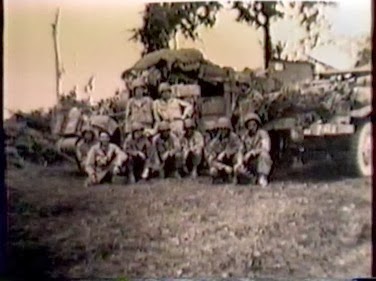
I have this picture from Dad’s records and assume this is of Unit 4 Battery A since the lower left looks like Jack Foreman.

From Dad’s After Action Records Unit 4 of 467th AAA Battery A consisting of the following personnel:

  1. Sgt. Robert Stratman
  2. Cpl. Homer Brown
  3. Cpl. Max Mays
  4. Cpl. Tom Goolsby
  5. Pfc. (TEC-5) Bill Macker
  6. Pfc. (TEC-5) Jack Foreman
  7. Robert Sumpton
  8. Cpl. Russel Picu
  9. Cpl. DeLoune
  10. Cpl. Merl
  11. Pfc. Stanley Slender
  12. Pfc. Charles Hagen (a.k.a., the Barber)

warphotos5-1994-08-24-16-35-1994-08-24-12-35.jpeg

This above picture is likely their M-15 halftrack. The M-15 teamed a 37mm cannon with two water-cooled .50 Cal machine guns. Ouch!

warphotos24-1994-08-24-16-35-1994-08-24-12-35.jpeg

The above is a picture of Dad (Bill Macker) with Jack Foreman TEC-5.

warphotos1-1994-08-24-16-35-1994-08-24-12-35.jpeg

Pretty sure the above is Max Mays who was deployed on the M16 halftrack writing a letter.

warphotos8-1994-08-24-16-35-1994-08-24-12-35.jpeg

This is definitely Max Mays behind the M-16 quad .50 caliber guns.

The M-16 is the second halftrack in their unit.

warphotos18-1994-08-24-16-35-1994-08-24-12-35.jpeg

Dad (Bill Macker) with chow somewhere along the Rhine River area protecting bridges.

You can see the M-15 dug-in with guns raised in the back to the left.

boysinthesnow-1994-08-24-16-35-1994-08-24-12-35.jpg

The boys in the snow somewhere (Dad is bottom middle).

Belgium, Luxembourg, Netherlands?


Next: 467th AAA on Omaha


Prelogue

Before we get started on the trip articles and more background.

This is copy of my Dad’s obituary that appeared in the Washington Post in 2010.

May 22 2010:

MACKER, William J.

WILLIAM J. MACKER (Age 85)

On Saturday, May 22, 2010, of Bethesda, MD. Beloved husband of Patricia F. Macker; father of Ann Marie Macker, John (Nancy) Macker, Margaret (Wayne) Jaquith, Mary Kay (Mark) Gillespie, Patricia (John) Winter, William Macker, Joseph (Sandra) Macker; brother of Evelyn Macker and the late Harold, Sarah, Katherine and Carrie. Also survived by 19 grandchildren, five great-grandchildren and many nieces and nephews. Bill was a WW II Veteran who landed on Omaha Beach the morning of June 6, 1944 (D-Day), served in 5 major campaigns, and received the Presidential Unit Citation. He worked for PEPCO, retiring after 39 years of service.

dad_army1-1994-08-24-16-25-1994-08-24-16-25-1994-08-24-16-25.jpg

But this is how I like to remember him. Smiling and enjoying the small moments. He deserved those moments. God Bless you Dad.

dadbeach-1994-08-24-16-25-1994-08-24-16-25-1994-08-24-16-25.jpg


Next: Unit Commendations for Battery A 467th AAA

Early Memories and Going Back as an Idea

First off, I would like say I have seven fantastic siblings and we all grew up in a moderately sized house in Bethesda, Maryland throughout a good portion of the 1950s-1970s. We had two loving parents who gave us a great start on life’s adventure. Our wacky suburban neighborhood is recalled by many who spent cherished childhood time there as “good old Edward Ave”. But those stories are for another time, we are here to talk about our Dad or “Pop-Pop” as he is known by his 19 grandchildren with lots of great grandchildren on the way at the time of this writing.

My personal interest in D-Day began at a young age as I often heard rumors and stories that Dad landed at some beach called “D-Day” when fighting in World War II. Yet these stories rarely came from Dad. He was proud of his service and loved to speak of his “brothers-in-arms” and the times they shared when the topic came up, but he rarely spoke of it focusing more on his family, his work, and his faith. This is a trait I appreciate and marvel at more as the years go by although I continue to yearn for more interesting stories about his time in Europe. He did little preaching but rather spoke through “action” on a daily basis. Never too busy to lend a hand, do a myriad of housechores (which he did almost religiously), or help someone in need even after a hard day’s work. Occasionally his war days would come out in small ways around the house. He used to “burn his toast” in the toaster on purpose and then scrape off the black carbon. When I asked him about this he would explain that in Europe they had a “gasoline” run camp stove and they would make their toast over the open flame and then scrape off the burn marks. He seemed to just like his toast that way even given more modern conveniences.

His smile was frequent and infectious at parties and as a child if that smile was ever erased something was wrong and you hoped you hadn’t caused it.

It is important to understand the deeper man a little bit before a story about one particular trip and one particular episode in his life. Rather than a “glory days” story I see these articles more as describing a very humble man who with many other recent high school graduates became involved in a series of extraordinary historical events that changed the world forever.

Again these articles are more about my experiences and knowledge about the events and if you were a young kid in the late 60s you couldn’t miss the constant barrage of WWII films on television. Classics like: “The Great Escape”, “The Guns of Navarone”, “The Dirty Dozen”, “Kelly’s Heroes” and even the TV series reruns of “Rat Patrol”, “Hogans Heroes”, and ”McHale’s Navy” were frequently shown. It was all good fun and soaking into our brains at the time. The nostalgic and adventurous Hollywood views of WWII were a strong influence and I was no exception to its infection often resorting to playing war games with friends in the nearby woods. Capture the flag type games with elm sticks where you would find yourself creeping quietly along the creek so you left no tracks for the enemy to follow as you escaped his prison camp. How fun it all seemed?

It wasn’t until my Dad invited me to go see the “Patton” movie in the 1970s at the Hoff Theatre at the University of Maryland that I really began to get a picture of what the European WWII conflict was like. A much more complex story for my father and for all involved. He kept saying things like “Yeah that’s what it was like for us”, “Nuts!”, “we were attached with the 3rd Army at Bastogne after Normandy”, “ we were at the Battle of the Bulge”, and “ the Bulge wasn’t too good for my brother Harold and his buddies in the infantry”. This was way different than what the movies could portray this was upfront and personal.

And then every once in awhile in years to follow the occasional “I’d like to go back to Europe someday to see things again but your mother wont get on a plane”. My mother did always say she wouldn’t get on a plane. The thought of getting on a boat to Europe was floated over the years but that never materialized perhaps for good reasons.

His D-Day landing itself was still a bigger mystery to me at this time but I was interested enough that I began reading stories about Normandy and over the years we had occasional opportunities to talk about other things that he could remember and his life in the AAA halftrack crew. I even took a side trip to Normandy while on vacation in Europe in 1990. My oldest brother John has a particular keen interest in war history and in the early 1990s we began slowly collecting as much as we could about Dad’s time in the service, his records, letters, unit commendations, including getting all his campaign medals and ribbons and my brother Bill made a nice shadow box for Dad that was presented to him by the family and all the siblings were there to enjoy it with him. I think this was a great experience to share with Dad as a family and the shadow box stands as a reminder to this day.

In the early 1990s, as the 50th Anniversary of D-Day was approaching there was brief discussions of maybe we could go back but plans seemed vague and distant.

How would this turn out? Keep reading the following articles if you’re interested.


Next: Prelogue

467th AAA Campaigns: the Long Road

I created the following google maps tour to follow some of the 467th AAA AW Bn Battery A first Platoon sites through their tour with notes on each location.

TBD

I have a more complete an accurate google tour of the deployment data week by week and published this recently on both the Google Earth history and military communities. If you search 467th AAA in Google Earth you should find it.

To summarize, the men of the 467th AAA Battalion participated in five major battle campaigns during their eleven months in combat. They saw action in nearly every major battle across northern Europe including the morning at Omaha Beach, the breakout at St. Lo, the Battle of the Bulge, and the crossing of the Rhine River around Remagen, Germany and later into western Czechoslovakia. They finished their tour in the Munich area acting military police near and after the war ended. The Battalion earned five Battle Streamers in total as follows.

Normandy

  • The 467th AAA Battalion was awarded battle participation credit in the Normandy Campaign by letter, Headquarters, European Theater of Operations, United States Army, file AG 200.6 OpGA, subject, Battle Participation Awards - Normandy Campaign (No 1), dated 16 November 1944. General Orders No. 102, War Department, Washington 25, D.C., 9 November 1945.a. Combat Zone: European Theater of Operations, exclusive of the land areas of the United Kingdom and Iceland.b. Time Limitations: 6 June to 24 July 1944.

Northern France

  • The 467th AAA Battalion was awarded battle participation credit in the Northern France Campaign by letter, Headquarters, European Theater of Operations, United States Army, file AG 200.6 OpGA, subject: Battle Participation Awards - Northern France Campaign (No 1), dated 1 December 1944, as amended, letter, Headquarters, European Theater of Operations, United States Army, file AG 200.6 OpGA, subject: Battle Participation Awards - Northern France Campaign (No 2), dated, 31 January 1945. General Orders No. 103, War Department, Washington 25, D.C., 13 November 1945.a. Combat Zone: European Theater of Operations, exclusive of the land areas of the United Kingdom and Iceland.b. Time Limitations: 25 July to 14 September 1944.

Rhineland

  • The 467th AAA Battalion was awarded battle participation credit in the Germany Campaign by letter, Headquarters, European Theater of Operations, United States Army, file AG 200.6 OpGA, subject, Battle Participation Awards - Germany Campaign (No 2), dated 5 February 1945. General Orders No. 118, War Department, Washington, D.C., 12 December 1945.a. Combat Zone: Belgium, Luxembourg, Germany, and France east of the line: Franco-Belgian frontier to 4 degrees east longitude, thence south along that meridian to 47 degrees north latitude, thence east along that parallel to 5 degrees east longitude, thence south along that meridian to the Mediterranean coast, except the area of the Ardennes-Alsace combat zone is excluded from 16 December 1944 to 25 January 1945.b. Time Limitations: 15 September 1944 to 21 March 1945.

Ardennes

  • General Orders No. 114, War Department, Washington 25, D.C., 7 December 1945.a. Combat Zone: Euskirchen, Eupen (inclusive), Liege (exclusive), east bank of the Meuse River to its intersection with the Franco-Belgian border, thence south and east along this border to the western border of Luxembourg, thence to Metz (inclusive), east bank of the Moselle River to Epinal (inclusive), Strasbourg (inclusive).b. Time Limitations: 16 December 1944 to 25 January 1945.

Central Europe

  • General Orders No. 116, War Department, Washington, D.C., 11 December 1945.a. Combat Zone: The areas occupied by troops assigned to the European Theater of Operations, east of a line 10 miles west of the Rhine River between Switzerland and the Waal River until 28 March 1945, and thereafter east of the east bank of the Rhine.b. Time Limitations: 22 March to 11 May 1945.

ASSAULT LANDING

  • In accordance with the provisions of paragraph 5f, section 1, WD Circular 465, 1944, the 467th AAA Battalion was designated as having participated in the Normandy Beach amphibious assault landing. Time Limitation: 6-7 June 1944. General Orders No. 70, War Department, Washington, D.C., 20 August 1945.

Next Post: Childhood Memories and Planning

Tuesday, August 23, 1994

What is this about?

Halftrack_crew-1994-08-24-03-17-1994-08-24-03-17-1994-08-23-23-17.jpg

Dad with his 467th AAA

Battery A Unit #4 Brothers in Arms

I always wanted to better capture the 1994 trip experience and the thoughts related to accompanying my father back to Europe and to the Normandy beaches where he landed on in 1944. Hoping this series of blogs can serve that purpose although they are written 15 plus years after the trip.  First off, I must apologize for my own reasons its taken too long to write some of this down and hopefully I finish most of what I want to capture in the next few months. But on the bright side, what has been good about having waited this long to record our trip activities is that some of the facts and location information about the 467th AAA become has become more available to me on the Internet and has also been additionally validated through multiple sources.

This series of articles is more about my experience with my brother and father on the trip so if you are perhaps interested in more of the 467th AAA details please see my publicly available google maps and tours of their entire deployment referenced in the first few intro pages. Also, if some of the stories seem unfinished its a work in progress while I gather photos and double-check stories and reedit the narrative.

There are many people that made our trip possible first and foremost my Dad, William J. Macker, who asked us to go with him, an incredible honor that I am forever grateful for, and my mother who supported this very strongly. My brother John as our traveling partner who did so much of the planning and pursued the trip with great ideas, excitement, and vigor. Our other five siblings who were strongly supportive always and kept Dad interested in pursuing the trip whenever it was mentioned. We constantly missed having all of them with us on the trip and hopefully these small stories help share some of the experience.

Joe - Sep 2012


Next Post: 467th AAA Campaigns